
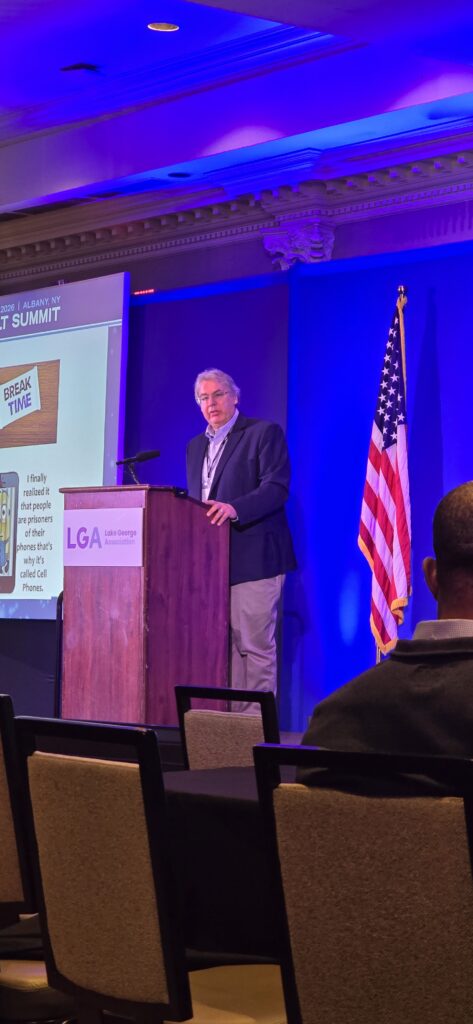
As rising sodium and chloride concentrations threaten drinking water aquifers, municipal reservoirs, and freshwater ecosystems across New York, environmental scientists, public works directors, commercial property managers, and state lawmakers assembled at the Crowne Plaza Desmond Hotel on Oct. 8, 2026, for the 11th annual Salt Summit — the first to expand into a comprehensive statewide forum.
Presented by the Lake George Association and the Lake George Waterkeeper in partnership with the Times Union, the event transitioned from its regional roots to address road salt pollution as a collective infrastructure and environmental crisis.
“In 2015, the Salt Summit was started as a commitment with local municipalities as part of our Lake George Road Salt Reduction Initiative,” said Lake George Waterkeeper Chris Navitsky.
“After our 10th summit, it was decided to bring the event to Albany to reach a wider audience who would be interested in collaboration, in action, and to catalyze change and improvement that we need to find a solution to this issue.”
The Emerging Science of Freshwater Salinization
Research presented at the summit revealed that road salt application — accounting for approximately 55 billion pounds of chemical de-icers used annually across the United States — is fundamentally altering the chemistry of New York’s streams, soils, and groundwater.
Sarah Whorley, associate professor of biology at Daemen University, outlined year-long ecological studies examining 30 streams across Western New York, Central New York, and the Hudson Valley. Whorley noted that salinity spikes are no longer restricted to winter thaw events.
“We used to think that road salt pollution of our water bodies was mainly just a wintertime problem, but there is an increasing body of evidence showing that it is affecting streams and other water bodies year round,” Whorley explained. “So we are consistently seeing our salinity levels rise above baseline year over year, even during the summertime.”
Whorley’s team observed that rising salinity correlates with increased concentrations of omega-6 fatty acids in stream periphyton (algae), which can disrupt aquatic food webs, while sensitive macroinvertebrates drop off significantly in highly impacted agricultural and residential watersheds.
John Jackson, senior research scientist at the Stroud Water Research Center, highlighted continuous monitoring data showing extreme chloride spikes in headwater streams.
“We suddenly started seeing spikes that we had never seen in the literature before,” Jackson said, referencing sensors that recorded stream conductivity levels exceeding 40,000 to 100,000 micro-siemens — concentrations as salty as, or saltier than, seawater.
Jackson emphasized that winter runoff is only one component of the crisis; the primary long-term threat is contaminated groundwater feeding streams during baseflow periods.
“Our road salt problem is a groundwater problem,” Jackson noted. “The salt doesn’t disappear.”
Changing Winter Patterns and Meteorological Realities
Climate data presented at the summit demonstrated that winter conditions across New York are rapidly warming and shrinking in duration, altering operational requirements for road maintenance crews.
Zachary Labe, a climate scientist with Climate Central, presented weather station analysis showing New York winter temperatures have warmed by more than 5 degrees Fahrenheit on average since 1978.
“New York State is actually seeing some of the fastest warming temperatures, some of the fastest changing winters for anywhere across the country,” Labe said. “On average, winters are warming. That does not mean we’re not going to have snow or we’re not going to have severe winters, but the frequency of which we experience these types of big storms, snowstorms, and these types of really extreme cold temperatures, it’s going down.”
Paul Caiano, chief meteorologist for WNYT Channel 13 in Albany, presented 30-year climate block data demonstrating that while total winter snowfall averages in Albany have fallen from the mid-60-inch range to under 60 inches, overall winter liquid precipitation is rising.
“We’re getting all this liquid, but we’re getting less snow. That means we’re having more rainstorms, warmer storms, but that can also mean more ice,” Caiano observed. “Even though we may be salting less, even though we may not have as many of these one or two inch snowfalls, we’re still having storms that can cause disruption in the form of ice, sleet, freezing rain.”
Mark Schanenberger, content project coordinator for True Weather, stressed that effective winter management must rely on pavement temperatures and event-specific weather intelligence rather than routine air-temperature application.
“What happens in the atmosphere obviously matters, but what happens on the pavement drives the treatments that we’re putting on paved surfaces,” Schanenberger said, noting that targeted liquid brine applications can prevent snow bonding while drastically cutting material consumption.
The Human Health and Drinking Water Frontier
The summit detailed how chemical road salt runoff penetrates municipal surface reservoirs and underground drinking aquifers, presenting acute public health risks.
Shannon Roback, science director for Riverkeeper, presented data evaluating drinking water supplies across the Hudson River watershed against federal and state health guidance values of 20 milligrams per liter of sodium for individuals on restricted diets.
“Over half of the drinking water supplies in the Hudson River watershed have sodium that is too high for people on very low sodium diets,” Roback stated. “Heart disease is the leading cause of death in New York State — you don’t really want to have to be worried about sodium from your drinking water.”
Roback added that elevated salinity acts as a corrosive agent, stripping heavy metals like lead from aging plumbing infrastructure and mobilizing nutrients in soil that trigger harmful algal blooms (HABs).
In Suffolk County, where approximately 1.5 million residents rely on a designated sole-source aquifer, Ty Fuller, director of strategic initiatives for the Suffolk County Water Authority, outlined how hydrogeologists differentiate between road salt runoff and ocean saltwater encroachment.
Using bromide-to-chloride ratio profiling, Fuller’s team identified that high chloride levels in critical public supply wells on the North Fork were caused by nearby municipal salt storage yards and highway runoff rather than ocean encroachment. In one instance, testing led to the discovery of an uncontained, 10-foot road salt pile situated near a local stream. When chloride levels approached New York’s 250 parts-per-million standard, the utility was forced to shut down a production well.
“This is a million-dollar well with treatment facilities,” Fuller said, warning that taking major wells offline in an area with fragile freshwater reserves creates “a catastrophic scenario” for community supply.
Adam Bosch, deputy director of strategy, policy, and innovation for the New York City Department of Environmental Protection, reported that chloride levels in the city’s southeast Croton Watershed reservoirs have doubled, tripled, or quadrupled since the 1980s.
“New Croton Reservoir is, with all things equal, going to bust that MCL [maximum contaminant level] in 2108,” Bosch warned, noting that salt accumulates in soil for decades and enters surface waters primarily via groundwater during dry summer months. “We can’t allow that to happen. This is 10 to 20 percent of New York City’s water.”
Legislative Frameworks and Policy Debates
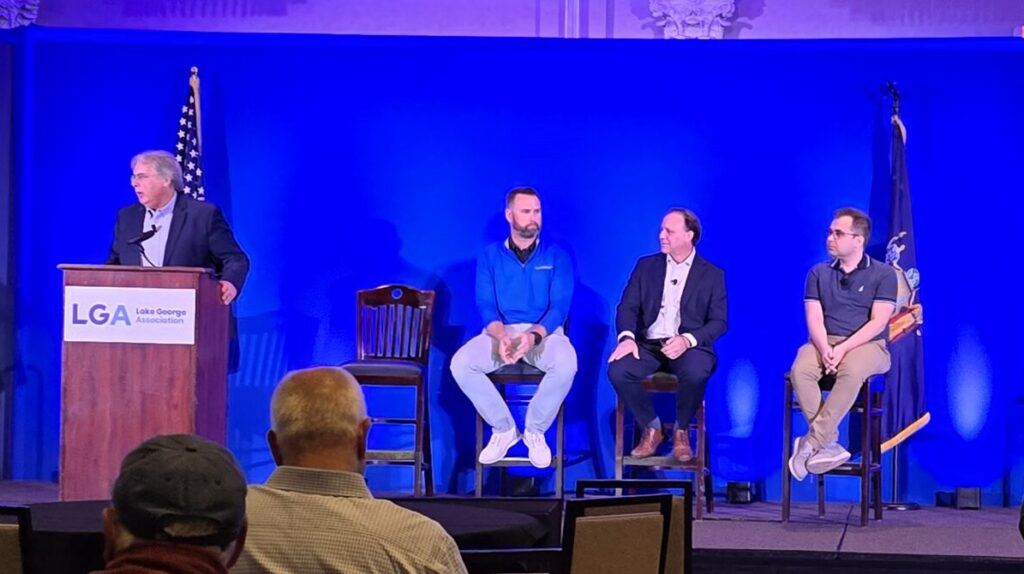
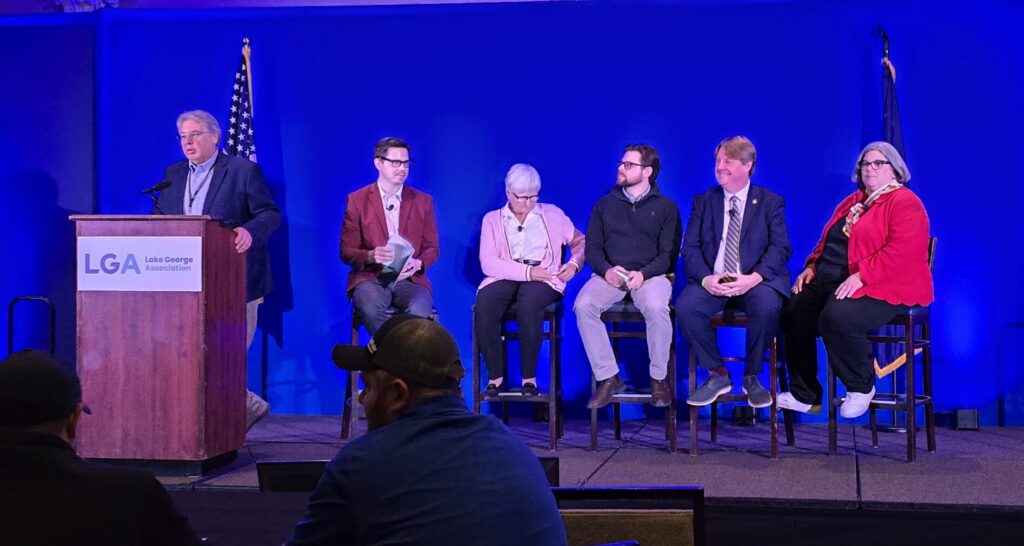
During a legislative panel moderated by Times Union Capitol Bureau writer Dan Clark, policymakers debated structural barriers preventing statewide progress.
Assemblyman Michael Cashman, D-115th District, highlighted his proposed legislation to establish a statewide road salt advisory council to foster collaboration among local practitioners, state agencies, and scientists.
“Sometimes that is the most empowering thing government can do is to actually set a table and make sure that there is a seat at the table for everyone,” Cashman said, advocating for increased Consolidated Local Street and Highway Improvement Program (CHIPS) state funding to fix local pavement so less salt is required.
Assemblywoman Carrie Woerner, D-113th District, called for breaking down state government silos between environmental funding and transportation infrastructure, advocating for targeted capital grants to help towns purchase brine equipment and retrofits.
“The state needs to be a partner with municipalities,” Woerner said, citing multi-jurisdictional watersheds like Saratoga Lake. “Not a state standard, but a conversation between all of the parties who have responsibility.”
Panelists and commercial contractors also addressed private sector liability laws, noting that property owners and private applicators often over-apply rock salt out of fear of slip-and-fall litigation. Representatives pointed to models in New Hampshire and Minnesota that offer liability protection to applicators certified in best management practices.
Municipal Realities and State Agency Initiatives
Transitioning from policy to municipal execution, state agencies and local highway departments outlined practical pathways forward.
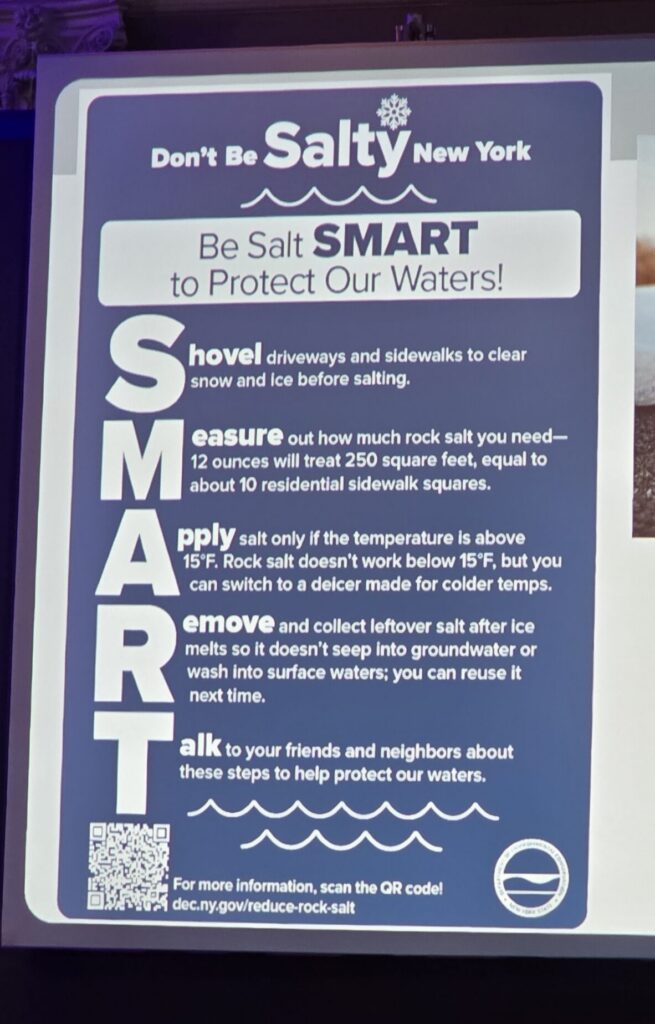
Leila Mitchell, environmental program specialist for the New York State Department of Environmental Conservation, detailed the agency’s “Don’t Be Salty New York” public education campaign and highlighted $30 million in Clean Water Infrastructure Act grant funding made available for municipal salt storage sheds, brine equipment, and live-edge plows.
In Saratoga County, the Town of Wilton provides a case study in how small municipal highway departments navigate severe salt supply constraints, changing residential growth, and costly equipment upgrades. Town of Wilton Highway Superintendent Mike Monroe, who oversees 14 plow routes covering 240 miles of roadway, highlighted the operational pivots required during supply shortages, such as mixing sand with salt and relying on alternative treatments like Magic-0 to stretch limited inventory.
However, alternatives like sand create secondary costs, requiring months of sweeping each spring with expensive specialized vacuum sweepers. To reduce overall salt dependency without relying as heavily on sand, Wilton focused on upgrading mechanical clearing methods. The town calibrated its existing fleet, outfitted all 14 trucks with live-edge segmented blades, and equipped newer dump trucks with computer-calibrated control systems.
“We realized that we were scraping more off the road than our conventional plow blade setup that we were using,” Monroe said. “And we discovered that on our final cleanup pass the drivers were able to turn their auger setting down a few clicks. So we were reducing salt on our cleanup because of the amount that we’re removing off the road.”
Scaling these mechanical and operational adjustments across New York’s 1,584 local government units is the primary mission of the Cornell Local Roads Program. Operating as the state’s Local Technical Assistance Program center, the program provides training and resources for municipal highway departments. Program Director David Orr stressed that effective winter maintenance relies on balancing risk management, public communication, and crew safety rather than relying on excessive salt application.
“You will not hear me say we’re trying to make the road safe. There is no such thing. We’re making them safer. But that’s a balancing act,” Orr told attendees.
Field studies presented by Orr highlight that up to 30% of dry rock salt immediately bounces off pavement into surrounding environments, while pre-wetting ensures it sticks, reducing total material loss to just 4%. By focusing on modern brining techniques, proper application rates, and covered storage, the program aims to help municipalities apply the right amount of material in the right place at the right time.

Private Sector Innovation and Commercial Maintenance
Near the southern basin of Lake George, the hospitality industry is demonstrating how commercial properties can curb chemical runoff while safeguarding visitors. Jennifer Clark, safety coordinator for the Fort William Henry Hotel & Conference Center, detailed how the historic 18-acre resort successfully transitioned away from heavy granular salt usage in favor of liquid brine treatments.
Starting small with walk-behind equipment before scaling across the resort, the facility now tracks applications three times daily, utilizes remote monitoring cameras to assess pavement conditions overnight, and rigorously logs application metrics. Through these combined practices and precise record-keeping, the resort documented a 500-pound reduction in salt usage.
“Start small. That’s what we did,” Clark advised.
In corporate retail, major companies are shifting from rigid time-and-materials contracts to performance-based agreements. Chris Howk, store maintenance manager for Wegmans Food Markets, described how the grocery chain transitioned 114 store locations toward sustainable winter management practices.
“We piloted some newer technology about 10 years ago in the Syracuse, New York, market area,” Howk said. “We really found a lot of success on our side from transitioning to a performance-based contract that advances the vendor over a series of five years into full compliance with using brine technology.”
Howk noted that Wegmans integrates site-specific thermal cameras and pavement condition tracking to reduce unnecessary chemical applications while protecting retail property infrastructure from salt corrosion.
Sustainable Standards and Regional Recognition
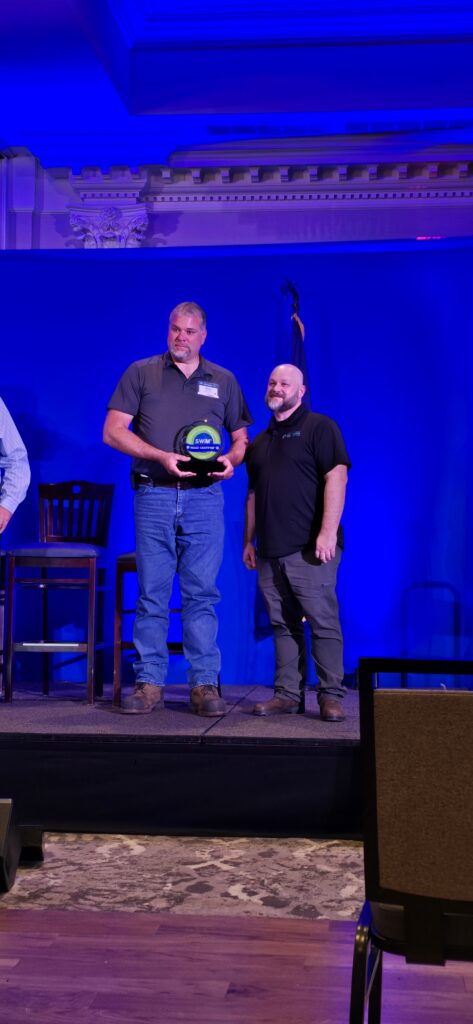
Central to bridging the divide between public agencies and commercial contractors is the work of WIT Advisers, an environmental management consultancy that partners with the Lake George Association and municipalities to implement Sustainable Winter Management (SWiM) standards.
During the summit’s closing ceremonies, WIT Advisers founder and CEO Phill Sexton, alongside senior adviser Rob Vopleus, presented honors to regional practitioners who have successfully embedded precision management into their operations.
Among those honored was Town of Wilton Highway Superintendent Mike Monroe, recognized for his leadership in advancing Wilton’s highway department through in-house training, retrofitting town plow equipment with live-edge blades, and achieving measurable salt reduction.
WIT Advisers also recognized Wegmans Food Markets for establishing sustainable retail standards, calling contractor partner Paul Fried, owner of Custom Lawn-Scapes, to the stage alongside Howk to showcase how corporate policy translates to contractor execution on the ground.
“If there’s any leader in the retail market in this right now, I’d have to say it’s Wegmans,” Sexton said. “It’s because they are enabling these standards of policy to enable the standards of practice that Paul is actually following now.”
Lake George Waterkeeper Chris Navitsky closed the conference by urging attendees from across the public, private, and regulatory sectors to form an enduring coalition.
“I think the only way that we are really going to address this issue and get some true change in the state is to do this together,” Navitsky said. “Let’s form a coalition, and together our voice for action will be heard. Let’s agree to set meeting dates and… start the first quarter of next year and see what change we can do.”
Organizational Guide
- Climate Central: A nonpartisan nonprofit organization of scientists and science communicators that researches and reports on the impacts of climate change, changing winter patterns, and extreme weather.
- Cornell Local Roads Program (CLRP): A program based at Cornell University serving as New York State’s Local Technical Assistance Program (LTAP) center, providing technical training, operational guidance, and best practices to more than 1,500 municipal highway agencies.
- Daemen University: A private, comprehensive university in Amherst, New York, whose biology department conducts freshwater ecology research on the effects of chemical salinization on stream food webs and periphyton across New York State.
- Fort William Henry Hotel & Conference Center: An 18-acre historic resort and conference facility located at the southern basin of Lake George that has integrated sustainable winter maintenance, liquid brining, and usage logging to reduce runoff into the lake.
- Lake George Association (LGA): A nonprofit watershed conservation organization dedicated to safeguarding the water quality, clarity, and ecological health of Lake George through scientific research, education, and community advocacy.
- Lake George Waterkeeper: A program of the Lake George Association that monitors water quality, investigates pollution sources, and collaborates with municipalities and businesses on watershed protection initiatives like the Lake George Road Salt Reduction Initiative.
- New York City Department of Environmental Protection (DEP): The municipal agency responsible for managing New York City’s 2,000-square-mile surface water supply system, operating 19 reservoirs and three controlled lakes that deliver more than 1 billion gallons of drinking water daily.
- New York State Department of Environmental Conservation (DEC): The state’s primary environmental regulatory agency, responsible for protecting natural resources, enforcing environmental laws, administering Clean Water Infrastructure Act grants, and leading public outreach campaigns such as “Don’t Be Salty New York.”
- Riverkeeper: A regional clean-water advocacy and environmental nonprofit that monitors water quality, tracks pollution, and works to protect the Hudson River, its tributaries, and the drinking water supply for New York City and lower Hudson Valley communities.
- Stroud Water Research Center: An independent freshwater research institute based in Avondale, Pennsylvania, that studies stream and river ecology, watershed restoration, and environmental stewardship across the mid-Atlantic and Northeast.
- Suffolk County Water Authority (SCWA): An independent public-benefit corporation operating under New York State public authority law that provides drinking water to approximately 1.2 million Long Island residents, managing one of the largest groundwater supply networks in the nation.
- True Weather: A private weather forecasting and meteorological analytics firm that delivers customized pavement-temperature guidance, winter threat intelligence, and application modeling for snow and ice management operations.
- Wegmans Food Markets: A regional supermarket chain based in Rochester, New York, operating more than 100 retail stores across multiple states, which has pioneered performance-based commercial contracts and liquid brine adoption across its properties.
- WIT Advisers: A sustainability and operations consultancy that works with public highway departments, commercial contractors, and corporate property managers to implement sustainable winter management (SWiM) standards and precision salting certifications.