Attending the Warren County Economic Development Corporation (EDC) Annual Luncheon on September 30th was a powerful reminder of not only how rapidly our regional economy is evolving, but also how strong it already is.
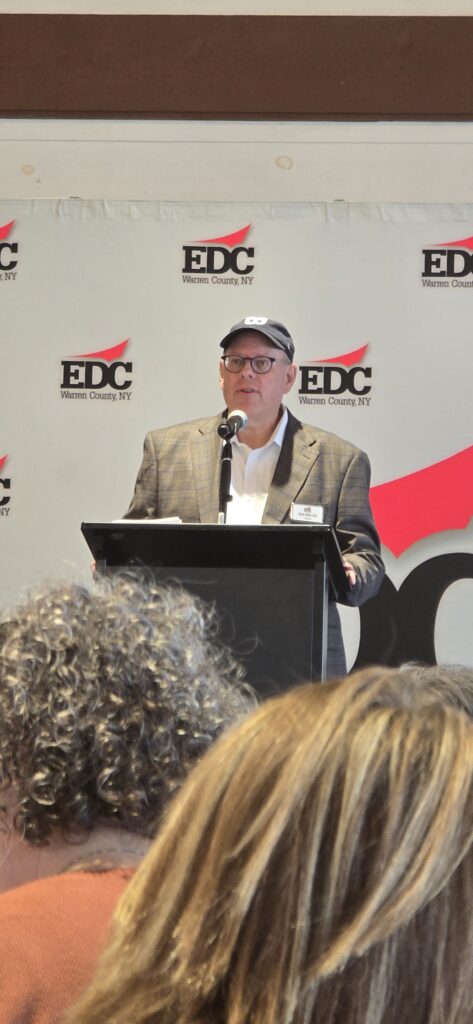
EDC President & CEO Jim Siplon opened the afternoon by framing our region’s distinct geographic and economic identity:
This community is unlike any other – not just in our area, but anywhere. We have the Adirondack Park to our north, which is a unique vestige. We have the Capital District to our south, which is an economic powerhouse, and we sit in between those two places looking to combine the best of both.
Jim put our workforce reality into sharp focus: “Our workforce is not big enough to meet our economy – that is true across the country. The communities that step into this intentionally will thrive.”
Here is how our regional leaders and national experts plan to step into that future, and my takeaways on what it means for our business community.
Small Business Leadership & Regional Collaboration
The EDC marked a significant milestone with the appointment of its new Board Chair, Melanie Fronhofer Weber, a local entrepreneur, co-owner of Grow children’s boutique in Glens Falls, and HR Manager at Common Roots.
Melanie brought an authentic, grounded perspective to the role:
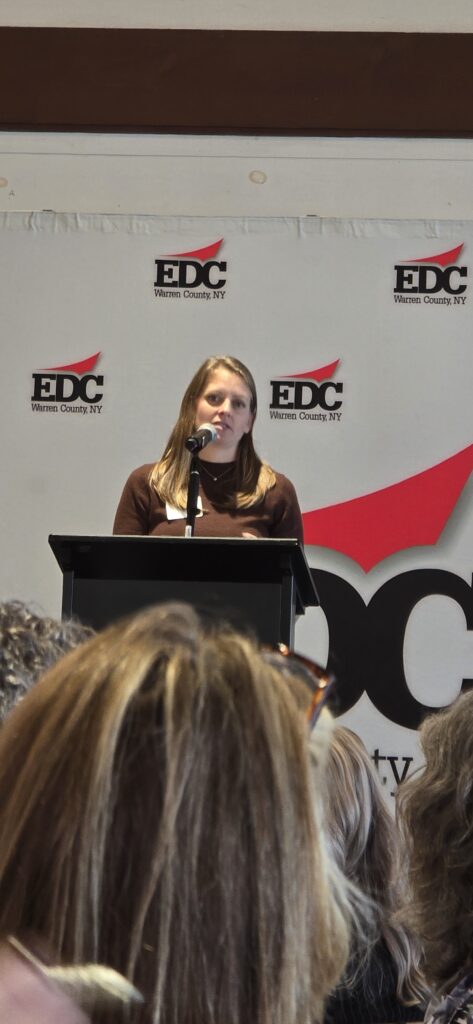
I don’t look or fill the role of your traditional EDC Board Chair – I’m a small business owner… Economic development isn’t just about recruiting the next large employer. It’s about making sure that business that’s been here thriving for 50 years can continue to grow. It’s about helping the entrepreneur open, and making sure that remote workers can find a home here and not just a place to work from home.
She emphasized that post-pandemic mobility has changed the rules of regional growth:
“You don’t have to be tied to a city for a job anymore. You don’t have to compromise opportunity for quality of life… Economic development doesn’t stop at a municipal boundary or county border. Collaboration across Warren, Washington, Saratoga, and the Capital Region is our greatest opportunity.”
Melanie’s appointment signals a critical shift. Economic development can no longer be a top-down recruitment effort focused solely on massive industrial projects. It must be an ecosystem strategy that amplifies the small business owner, the remote worker, and the local entrepreneur. When we break down county silos and build a connected regional table, everyone wins.
National Talent Attraction Data: Quality of Life & Feasibility
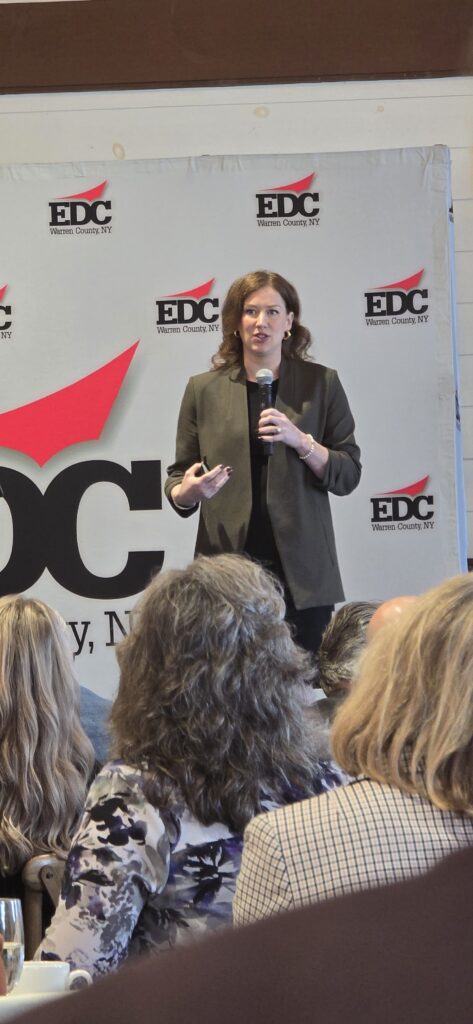
Keynote speaker Patience Fairbrother Wallace, Senior VP of Talent Attraction at Development Counselors International (DCI), presented data from DCI’s national relocation study alongside Lightcast research predicting a national shortfall of 6 million workers by 2030.
Patience cut right to the core of modern talent recruitment:
I don’t recruit for companies, I recruit for places… Post-pandemic, people aren’t just moving for jobs. They’re trying to evaluate: does this place offer me the kind of future that is worth upgrading for?
She shared several defining findings for our region:
- “Feasibility is the new gatekeeper”: Over 60% of workers are open to relocating, but feasibility (housing, moving costs, childcare, and career risk) determines whether they actually move.
- Quality of Life Drives Decisions: 50% of talent now rate quality of life as more important than a specific job offer.
- “Today’s Visitor is Tomorrow’s Talent”: Travel, personal experiences, word-of-mouth, and digital storytelling are the top drivers of relocation decisions, with the active decision window lasting just 3 to 6 months.
Patience also offered a crucial strategic warning for Warren County:
Lead with lifestyle value, not just affordability. We would never want to position this region as a cheaper alternative… It’s about the value you get for the money here… Don’t just generate interest – you have to build the capacity to receive it.
Patience’s research confirms what many of us feel intuitively: lifestyle value is our superpower. But we cannot market ourselves as simply “cheap.” We must communicate high quality of life: safety, shorter commutes, outdoor access, and rich culture; while actively building the local housing and social infrastructure required to welcome new residents smoothly.
The Un-Silicon Valley Case Study: Enterprise Web
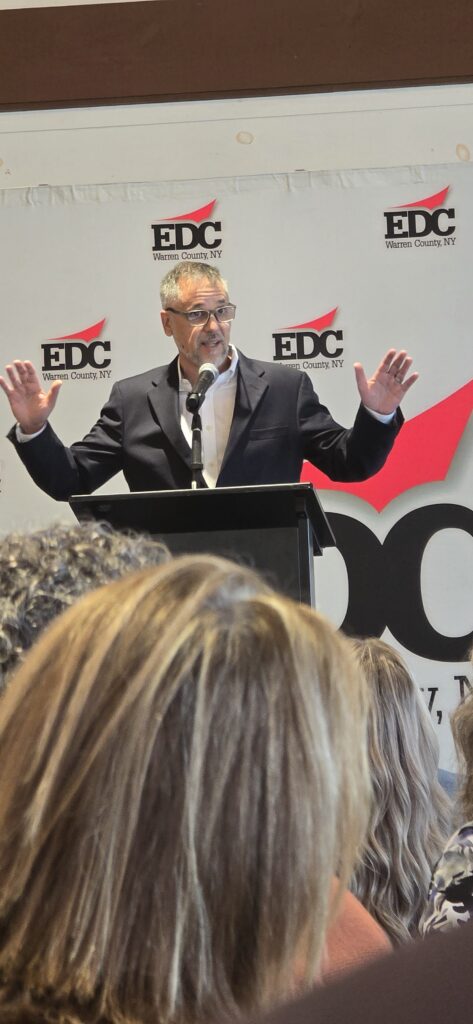
To prove that world-class innovation is already happening here, Jim Siplon introduced Dave Duggal, Founder & CEO of Enterprise Web, a global enterprise AI software company with 23 awarded patents.
Dave chose to bootstrap his company from a home in Glens Falls rather than setting up shop in Silicon Valley:
We chose Glens Falls intentionally over Silicon Valley to raise ‘fresh air, free-range kids.’… When I founded the company, the conventional wisdom was: go to Silicon Valley, get venture funded. Silicon Valley is the most expensive real estate market in the world, and I’d be competing against Google, Cisco, and Microsoft. That didn’t make sense to me.
Dave highlighted the mental clarity that living in our region provides:
“My blood pressure goes down… when I cross the Hudson River on Exit 18, I’m almost a human again. When I shut down my computer, I learn from business people in other fields. That removes the cognitive overhead and allows me to think.”
He also noted the global prestige of our regional brand when dealing with Fortune 500 executives:
“The feelings people have about this region around the world are all positive. Almost every executive I meet globally has vacationed here, camped here, or has family ties here. There’s an authentic prestige we can leverage.”
Dave exemplifies the core insights of Patience’s research. Leading innovators seek out community, work-life balance, and natural surroundings rather than high-stress, hyper-inflated tech hubs. Far from being a fallback, our region presents a top-tier strategic advantage for premier business leaders. Hearing Dave speak brought back memories of my early digital marketing career in Ireland – often called the Silicon Valley of Europe. Based in West Cork, an area with striking parallels to the North Country, I collaborated with entrepreneurs who had previously worked with tech powerhouses like Apple and Motorola.
Sustaining the Ecosystem: Youth & The Arts
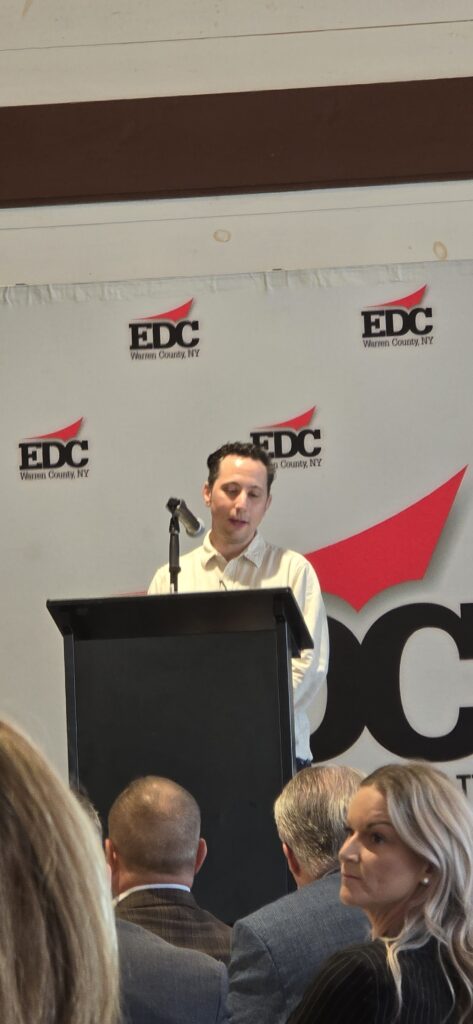
The event also highlighted two vital pillars for our long-term regional health:
- Engaging Future Talent: Jim Siplon introduced a delegation of high school students and staff representing school districts in Warren County, emphasizing that keeping young people engaged through exposure and local internships is key to solving our demographic drought.
- The Cultural Economy: Jim Siplon and LARAC Executive Director Phil Casabona detailed the growth of MOSAIC (Mobilizing Support for Art, Innovation, and Culture), a coalition that now unites over 80 arts and cultural non-profits across Warren and Washington counties.
A community that attracts talent must also nurture its own. By connecting local high school students directly with business leaders and uniting over 80 arts organizations under one umbrella, Warren County is actively building the social fabric that turns temporary visitors into lifelong residents.
The Strategic Bottom Line
The takeaway from this year’s EDC Annual Luncheon is clear: Our story is our greatest economic asset, but it must be told with authority and intent.
This exact mission inspired the founding of North Country Media Network. My goal is to empower local entrepreneurs, visionaries, and civic leaders to convert their industry knowledge into influential authority assets that elevate both their individual brands and our surrounding region. By broadcasting genuine accounts of local innovation, premier quality of life, and cross-community partnership, we can craft a compelling regional story that draws the premier talent and economic investment our community merits.
Other content on this site that relates to regional development: